Benefits of Using a Dog Harness for Leash Walking — and More!
As dog lovers, we always want to make the health and safety of our pups a priority. So, when it comes to dog walking, is a collar enough? Or should you be attaching your dog’s leash to a harness? Simplify the decision-making process by considering the following points:
Protect Sensitive Areas & Vital Structures
When dogs pull on a leash attached to a neck collar, it can put increased pressure on their necks, potentially injuring areas such as the eyes, thyroid, lymph nodes, trachea, and spine. The usually overlooked, delicate structure of their necks makes them very vulnerable to damage. A 2006 study published in the Journal of the American Animal Hospital Association noted that the intraocular pressure (pressure inside the eyes) increases significantly when dogs pull against a collar, as opposed to the same amount of force in a harness.
Even if your dog isn’t a big puller and it isn’t obvious that the collar is causing any harm or injury, eventually, this repetitive trauma will lead to discomfort for your dog — no matter if they are big or small.
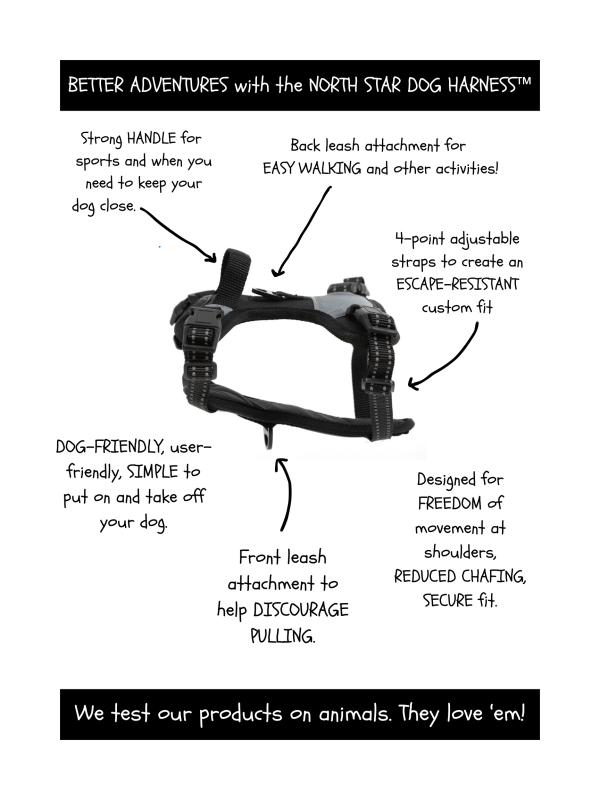
The IC Original Design, North Star Dog Harness™
Emotional Well-Being
For dogs who are more enthusiastic and will start running and hit the end of the leash with great force, a collar that pinches, constricts, or chokes can lead to dogs forming negative associations with what they are pulling towards. These negative associations (fear, pain, discomfort) in turn, can cause dogs to react in the future, barking or lunging towards (or attempting to run away from) this person, animal, or object when next encountered.
Fewer Houdini Maneuvers
A well-fitting harness can keep the leash where it’s meant to be: attached to your dog! Often, dogs learn how to slip out of collars (and some harnesses) that aren’t fitted correctly, which is dangerous for them and you. It is imperative to make sure that you choose pet gear that is properly fit and does not go on simply by slipping it over the dog’s head. When you can safely and humanely overcome escape issues, you and your inquisitive canine can enjoy peace of mind when you’re out and about.
Dog Harness Selection Made Simple
Dog harness shopping for your precious pup can be easier than you might think. Yes- there are lots of options out there. But you can ask yourself a few basic questions when selecting a harness and you’ll quickly see the number of good options dwindle. When you are choosing a harness for your inquisitive canine, look for these features:
COMFORT – Design and materials that provide a lightweight, comfortable, escape-resistant canine fit to keep dogs comfortable and secure.
REDUCE PULLING, NO CHOKE – Versatile enough for any adventures that come your way: A front leash attachment option to help reduce pulling, a back clip to attach a leash for traditional walks and other activities, plus a utility handle for sports.
SAFETY – Designed to be fastened around the neck, like a regular collar, rather than slip on or off over the head (which some dogs might be able to back out of and escape). Reflective webbing for low-light conditions.
DURABILITY – Made for extended wear; two sturdy leash attachments; ruggedly constructed; water-friendly and easy to clean, so pet parents can feel free to let your dogs be dogs!
EASY-TO-USE DESIGN – A people- and dog-friendly harness is simple to put on and take off of your dog with smooth clips and easily adjustable straps. An adjustable custom fit can help prevent dogs from slipping the harness off or wriggling out of it.
The best harness will be escape-resistant, yet comfortable for your dog, without restricting movement or causing chafing or rubbing, easy for you to use, and easy to keep clean. A well-fitting harness is the best bet to ensure the health and safety of your pup.
Ready to unleash adventures and harness fun with your dog?
As a certified professional dog trainer and professional canine behavior consultant, human-canine relationship coach, and owner of The Inquisitive Canine, I designed The North Star Dog Harness™ to reduce chafing and offer freedom of movement, without the risk of canine jailbreak. It is simple to take on and off and its two-clip versatility feature reduces pulling and is perfect for traditional walks and other activities. But most importantly, the design of The North Star Dog Harness™ allows dog guardians to decrease time worrying about their dog’s safety so they can spend more time unleashing adventures and harnessing fun!
Reference
Pauli AM, Bentley E, Diehl KA, Miller PE. Effects of the application of neck pressure by a collar or harness on intraocular pressure in dogs. J Am Anim Hosp Assoc. 2006 May-Jun;42(3):207-11. doi: 10.5326/0420207. PMID: 16611932. https://pubmed.ncbi.nlm.nih.gov/16611932/